Posts mit dem Label Sorcerer Kings Guide english werden angezeigt. Alle Posts anzeigen

Dienstag, 9. Dezember 2025

Sorcerer Kings Army Review: Tier List and Insights for Beginners

UPDATE August 2026: The update and the new regiments have been added, and the classification has been changed to match the Nords article.

Hi everyone,

after having written tier lists for City States, Dweghom, and Nords over the past few months, one request kept coming up from our player group around Bremen and Bremerhaven: “Could you do something like this for the Sorcerer Kings as well?”

So this assessment is my very own personal opinion. It reflects how I evaluate the units in their roles, what impact they have on the game, and how they can be combined within the army. None of this has to be mathematically perfec, some things, like the Mahabmarati, I play simply because I think the models look great. That’s why they’re rated higher for me than they might be for others. <-- thats old, new Mahabharati are insane^^

A quick overview of the ratings, and then we’ll get started:

S-Tier:
Units that are considered overpowered due to their rules or efficiency. They are often seen as must-picks because they improve almost any list.

A-Tier:
These units are among the best in an army. They shine in their roles and often form the core of competitive tournament lists.

B-Tier:
Solid and well-rounded units with strengths and weaknesses. They perform their role well but have clear limitations. In my opinion, all regiments and characters should ideally fall into this category.

C-Tier:
Units that are rarely seen and seem inferior compared to similar options. They often have room for improvement but are still playable, just less efficient than their alternatives.

D-Tier:
Units that are considered unplayable or in urgent need of a rework. For new factions, this may be because they are waiting for synergies with future releases.

rten.


Faction Mechanics

Rituals

Rituals are now built up over several steps and then played as Command Cards. At the end of the Supremacy Phase, you choose a Ritual and begin collecting Ritual Markers for it. Spells and Regiments with the Elemental Conduit Draw Event provide these Markers for Rituals that share a Court with them. In addition, the first Ritual each round starts with a number of Ritual Markers equal to the current round number, up to a maximum of 5.

Once the Threshold is reached, the Ritual is completed and moves into your Command Stack in the following round.

Sorcerous Patronage & General Information on the Sorcerer Kings' Mages

All three types of characters, Maharajah, Raj, and Sorcerer, can choose a Court and automatically know all Spells and Rituals associated with that Court. The Spells only affect Regiments belonging to the same Court and are specifically designed to enhance the strength of the corresponding Element. None of the Paths is bad, and all of them offer very convincing buffs and offensive spells.

For the Sorcerer Kings, Dhanur and Rajakur can be taken as a fifth selection in a Warband. Brutes belonging to the same Court as the character count as Mainstays, providing a virtually free list-building option.

In addition, characters pass their Court on to Rajakur and Mortals, while the Warlord passes their Court on to the Mahabharati and Ghols.

Therefore, it is important to make sure that your preferred buffs are affecting the right units. At the moment, however, most players tend to run mono-element lists in order to make the synergies within their chosen Court as effective as possible.


Characters

Maharajah, B-Tier and A-Tier as Warlord

For 120 points, the Maharajah brings Wizard 8, Resolve 4, and a solid melee profile, making him enjoyable to play based on his stats alone. However, the main reason to take him is his Supremacy. It not only allows him to choose a second Court, but also lets him start a new Ritual with a different Court after completing a Ritual. This gives you the opportunity to add up to three additional cards to your deck. This comes with both advantages and disadvantages, but due to the effects of most Rituals, it is generally considered more of a benefit.

His second major strength is his role as the preferred Mahut rider. This makes the Mahut one of the most reliable anchors in the game while also providing a solid combination of magic and support. Although he is almost always taken as the Warlord in this setup, this would be the only way I would consider running him as a non-Warlord.


Raj, A-Tier and C-Tier as Warlord

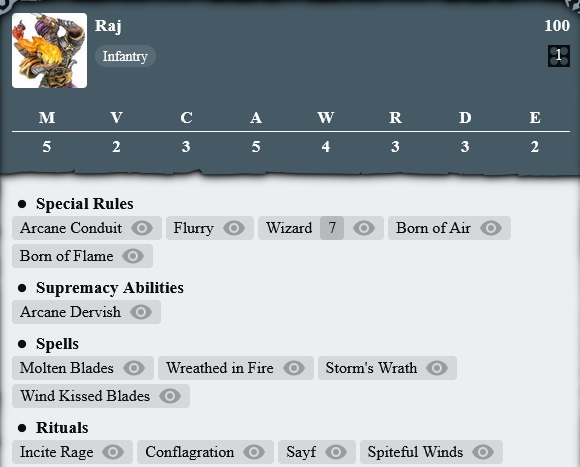
For 100 points, the Raj brings everything you would expect from a solid battle mage: Wizard 7, Resolve 4, and Flurry. This often makes him my first choice among the characters, as he casts reliably, is flexible, and, like all mages, can freely choose his Court.

However, I now only consider his Supremacy interesting in the Court of Air. There, it grants Opportunist to all Court of Air Elementals, resulting in a noticeable increase in damage output. In the other Courts, the requirements for his Supremacy are either too cumbersome or too rarely relevant, making him a poor choice as a Warlord in those cases.

My favorite place for the Raj is among Ghols from the Court of Fire. Together with them and Molten Blades, he can reliably wipe out MSU Regiments while simultaneously providing cheap and mobile magical support.

The most popular build at the moment, however, is Raj with Bound to the Elements and Prijm Khanjar. This allows him to join any Regiment belonging to his Court and adopt its Unit Type. This turns a solid melee fighter into a beast with 9 Attacks, Flurry, Flawless Strikes, and 3 Impacts, all for only 135 points.

Overall, the Raj is the most flexible and probably the strongest all-rounder among the characters. His greatest strength lies in the combination of his low cost, reliable magic, and the ability to use him in very different ways depending on the list.


Mahabharati Sardar, D-Tier

For his points cost, the Sardar simply does not bring enough to the table, making him the weakest character in the faction. He exemplifies several fundamental design problems: he is too expensive, inefficient, and clearly outperformed by the other characters. On top of that, you generally do not want to spend Ritual Tokens on the relatively small buff he provides to Rajakur or Mahabharati, even though I consider the buff itself quite solid.

The Sardar does not generate Ritual Tokens, has the least appealing and only restricted Warband, and his buffs only affect a small number of units, such as Rajakur or Mahabharati Initiates. At the same time, alternatives such as the Raj or Maharajah are cheaper, more flexible, have higher Resolve, and are stronger offensively.

The Flank rule added with the update can slightly improve his effectiveness, but it is not enough to compensate for his fundamental weaknesses. As a result, the Sardar remains difficult to justify in most lists.

Overall, he is practically only played in highly restrictive or experimental lists. For a standard competitive list, there is little reason to choose him over the other characters.


Sorcerer, B-Tier and B-Tier as Warlord

At 90 points, the Sorcerer is the budget mage of the Sorcerer Kings. She provides a full Wizard with a free choice of Court, but has a weak melee profile in return. Her role is therefore primarily to provide cheap magical support and additional list-building options.

She is generally taken for one of two reasons: either because of her powerful, but list-restricting Supremacy, or because she provides an inexpensive way to unlock an additional Warband.

Since the update, she also has the same range as the Dhanur. Especially in the Court of Water, this makes her a solid buffer for the Regiment she joins, while still allowing her to contribute some damage of her own.


Regiments

Dhanur Disciples, C-Tier

Since the justified nerf to the Court of Wind Spells and their reduced range, they have disappeared from almost every list. If they were a Light Regiment, we would probably see them taken in pairs more often, but in their current form, they simply do not offer enough to the faction. The first picks in Rounds 2 and 3 are always occupied, meaning they only arrive on the battlefield relatively late. By that point in the game, they are often already obsolete.

On top of that, they are one of only two Regiments in the faction that do not generate Ritual Markers. This makes it even harder to integrate them effectively into a list.

If you still see a few Regiments of them being played, they are usually accompanied by a Court of Water Sorcerer, who has a reasonable chance of granting the Regiment Aimed Shot with Lamellar Flow. Whether that is worth 220 points, however, is another question entirely.


Efreet Flamecaster, C-Tier

The Efreet Flamecasters are the ranged version of the Court of Fire's Medium Brutes. Since the Chios update, however, they have suffered some significant setbacks: Homing Winds and Lamellar Flow can no longer be cast on them, and they only gain Rapid Volley when they themselves are Inflamed. At the same time, they can no longer set enemy Regiments on fire with their ranged attacks.

As a result, they usually score only 5 to 6 hits without Aiming, or around 8 with Rapid Volley. Considering their range of only 14", this is simply not enough for 170 points. These factors severely limit both their damage potential and their role in the activation sequence. On top of that, only one Fiery Dominion is available per round, the Ritual that sets the army on fire and heals it.

While you can still occasionally see one or two Regiments of them, they are increasingly disappearing from competitive lists. Without further adjustments, there are currently very few reasons to take them.


Efreet Sword Dancer, A-Tier

The Sword Dancers are the Court of Fire's Medium melee Regiment and one of the best value-for-points units in the army book. They have the potential to generate more hits than almost any other Regiment and remain effective even against Dread Regiments or in Hindering Terrain thanks to Relentless Blows.

With the fire Ritual Fiery Dominion, they can heal themselves and go from moderately durable units to genuinely tough Regiments. Molten Blades provides additional damage and Inflamed. The fact that Inflamed activates the Juggernaut rule, allowing them to charge 11" automatically, rounds out the package nicely.

The only downside is that there is really no way to get them onto the battlefield any faster. Your opponent therefore always knows exactly how far they can advance in a given round.


Ghols, B-Tier

The Ghols are the only and therefore often essential Light option available to the Sorcerer Kings, while also being the cheapest Regiment in the faction. They are usually used as cannon fodder or as a living screen, but they can also carry Characters, which is particularly useful in the Court of Fire.

With Movement 5 and Vanguard 4, they get onto the table early and protect important troops while simultaneously generating Ritual Tokens. Buffs from the Court of Fire, such as Molten Blades or Fiery Dominion, significantly increase their damage output and make them dangerous against almost any Regiment. Adding a Raj to the unit increases the threat even further.

Despite this offensive potential, they remain fragile, as Defense 2 and Resolve 2 make them vulnerable to practically everything, including ranged attacks.

Typically, two units are played, while mono-Fire armies can field up to four in order to make effective use of their Characters and get the most out of the unit.


Mahabharati Initiates, S-Tier with Fire, A-Tier in the Other Courts

The Mahabharati Initiates are an inexpensive Medium Infantry Regiment that excels primarily in direct engagements against units above their own price range. Cleave and Linebreaker give them enough punch to reliably threaten durable melee units such as Knights or Praetorians.

Since the update, they also have Tenacious 1, giving them an additional point of durability and ensuring that they do not simply collapse at the first sign of contact. Once you have two or more units, the 35 points for Recorder of all Deeds are always worth spending and should also be purchased by the Warlord.

They always count as belonging to the Court of their respective Warlord and receive buffs based on the Court they belong to. Fire granting them Juggernaut is particularly absurdly good.

An important point, because many people play this incorrectly: Earth's Regeneration is a Draw Event, just like Elemental Conduit, and therefore cannot be used in the same round as Elemental Conduit. Regeneration also happens before Bravery, meaning it cannot be used to heal Broken Regiments.

Another advantage of the Mahabharati is that enemy Spells have a harder time affecting them, while their own Spells automatically succeed.


Mahut, C-Tier without Rider, A-Tier with Rider

For me, the Mahut is one of the least appealing models in the faction. It is slow, deals comparatively little damage, and is also a Heavy, which further limits its applications.

As a Medium Monster, it would probably be considerably more interesting, as it fundamentally provides something the faction otherwise lacks: durability. However, the combination of melee and ranged options feels somewhat incoherent.

What makes the Mahut playable nonetheless, and the reason I brought one to a tournament again after the latest update, is the Mastery Favored of Hormus, which allows a Maharajah, or theoretically even a Sorcerer, to ride the Mahut.

In this configuration, the Mahut loses its Barrage value, which was rarely useful anyway, but gains Terrifying 1 and effectively becomes Untouchable. The Mage has to belong to the Court of Earth, but the situational support Spells of the Earth Path have so far always been solid and consistently useful.


Marid Apsara, A-Tier

The spellcasting variant of our two new Water Monsters is an expensive, mobile buff bot with solid damage potential. All Court of Water Regiments receive bonuses while standing in water. But what if there is no water on the table? No problem. Within 8", friendly Regiments with the Water Elemental Rule count as being in water, allowing them to trigger all Rituals and special effects.

On top of that, she is Wizard 7 with Aqueous Branding, which improves the Spells of other Wizards. She also has access to Untouchable herself. Combined with her ability to make enemies count as being in water when performing Clash Actions, this can make her surprisingly durable.

In addition, all Water Regiments can choose a unit-specific ability each round. The Apsara has the choice between a free Spell and additional range on her Spells.

All of this is nice, but does not necessarily justify her Heavy classification. However, she has the option to bring another Water Regiment onto the battlefield with Tidal Summons, allowing you to reliably have two Heavies on the table by Round 3.


Marid Lancer, B-Tier

I am generally not a fan of Impact Cavalry in the game, and the Sorcerer Kings' version is no exception. They also have a special Tidal rule, allowing them to choose at the start of their activation between +2 Impacts or Brutal Impact +1. The latter is only better in a few exceptional situations.

At least they have Vanguard, allowing them to actively contest zones, and they also gain Juggernaut if they begin their Charge in water. This creates a great synergy with the Apsara. However, the best thing about them is that they give the Sorcerer Kings something they previously lacked: they can deliver melee hits through a unit that otherwise has no Reach, which is often interesting enough to make them worth considering.


Marid Sahar, B-Tier

Relatively expensive, but blessed with plenty of synergies thanks to the new Water Regiments and made even more interesting by Aqueous Branding. Their very short range of 12" for both their ranged attacks and Spell is initially a disadvantage. In return, they gain either +2 Wizard or +2 Barrage each round, which also makes them useful in matchups with a lot of Interference.

However, you should get rid of the idea that this Regiment can do enough on its own. Without support, even their defensive profiles run out of steam very quickly.


Marid Shaytan, A-Tier

In theory, it should always be more efficient to play two Apsaras, but the Shaytan has 15 Attacks, Cleave 2, and Terrifying 2 and that is just fun. Lots of fun.

With Movement 8, she gets into zones immediately, enemies count as being in water for Clash Actions, and her Aura grants Water Regiments Terrifying +1, bringing herself up to Terrifying 2.

Together with the Apsara, the Shaytan can also become very durable and reliably make it onto the battlefield. If she ever has no worthwhile Charge and cannot Clash, she still has the option to double her Impact value instead of gaining additional Attacks and then crash into the enemy with 12 Impacts. She will usually survive the Echo, but the opponent will not survive the Clash that follows.


Rajakur, C-Tier

The Rajakur are solid Medium Infantry units that are well protected against light ranged attacks and occasional attacks thanks to their Shield and Hardened 1. This would normally make them a good choice for holding zones or safely bringing Characters onto the battlefield.

Unfortunately, they only have Movement 5, which is usually not enough to reach zones even with Vanguard from Recorder of All Deeds. On top of that, they do not generate Ritual Tokens, and Wizards can now be assigned to other Regiments. As a result, they are almost exclusively used as a larger block with a Mage who has Elemental Feedback as their Mastery, allowing the unit to be healed.

With a Maharajah Warlord from the Court of Air or Fire, you can additionally cast Molten Blades and Air Step on them, making them genuinely threatening. The problem remains, however, that the respective Courts usually have better options that also generate Ritual Tokens.


Rakshasa Bakasura, C-Tier

One of the two large Court of Fire Monsters. Unfortunately, he is a Heavy with only Movement 7, meaning he cannot reach zones directly.

His special rules do allow him to reliably threaten Regiments with Characters at 11", or even 15" while Inflamed. He needs this increased threat range, because his actual damage output is not remotely proportional to his high points cost.

However, the significantly greater threat range compared to the other melee units of the Court of Fire allows him to apply somewhat more pressure. This is why he has started appearing in the occasional Sorcerer Kings list again.


Rakshasa Ravanar, C-Tier

For me, currently the stronger of the two Court of Fire Monsters, but he suffers even more from Movement 7, as his additional Charge bonus only works against Monsters.

On paper, Fiend Hunter looks excellent, but in reality, many Monsters in Para Bellum currently have Evasion 2, Fearless, or similar defensive effects that make them almost immune to the profile that should naturally be their counter.

As a result, the Ravanar tends to prefer Brutes in practice. He handles them reasonably well as long as he gets the first strike. Even so, he feels roughly 10% too expensive to be truly efficient, as Hubris will presumably never allow him to also gain +3 to Charge against Brutes.


Steelheart Djinn, B-Tier

The Steelhearts are the obligatory Medium Brute melee Regiment of the Court of Air. With five Attacks, Cleave 2, and three Impacts, they offer a good balance of offensive power and quality while remaining points-efficient.

Their Movement 7 makes them fairly mobile, but it is often not enough to reach zones directly. They also have no rules that make their Charges more reliable, such as Unstoppable. As a result, they often rely on good positioning or the Air Spell Air Step, which increases their Charge range somewhat. This dependence on Spells limits their independence to some extent. Both On Soaring Winds and the Air Elemental special rule are too situational and awkwardly worded to have a decisive impact very often.

RAW, one could argue that Soaring Winds actually consists of two separate Actions, while the Evasion bonus from Air Elemental is only triggered by Move Actions and not by Reform or Charge Actions.

Nevertheless, seeing two to four Regiments in mono-Air armies is quite common. 


Trinavarta Chandavat, B-Tier

As a Medium Monster, he is fast enough to reach most zones directly from Reinforcements. With 16 Wounds, Defense 3, Evasion 2, or 3 after moving, and Resolve 4, he is already reasonably durable. Thanks to Tenacious 1, he is particularly resilient against ranged attacks when in Cover, forcing the opponent to engage him in melee. And that is exactly where he is just as dangerous as he is at 12" range.

Each round, he can throw up to 18 dice at enemy Regiments. He can also generate additional hits when those Regiments are in contact with a Wind Regiment, such as the Chandavat itself. Unfortunately, he requires support from the Wind Rituals, which are no longer quite as impressive as they once were. However, two well-played Chandavats can single-handedly dominate an entire flank against the right opponent.


Trinavarta Sabhagrih, C-Tier

The Trinavarta Sabhagrih is the second Medium Monster of the Court of Air and closely resembles the Chandavat in both profile and appearance. However, he carries two swords, cannot cast Spells or make ranged attacks, and is 20 points cheaper.

In the current meta, I consider the Sabhagrih only situationally useful. While he is one of the few Regiments in the faction that can reach a zone directly from Reinforcements, the damage he can potentially deal is simply too low for his points cost.

With Elemental Tether, however, he has a valuable ability that allows a Court of Air Spellcaster to cast buffs on friendly Regiments within 8" of the Sabhagrih. These do not necessarily have to be Court of Air Spells. This allows the Sorcerer Kings' powerful buffs to be brought to flanks where no Mage is present or where you do not want to commit one.

His main problem, however, is that he has no Cleave option and for 220 points achieves “only” 12 normal hits in the Clash. Therefore, the Chandavat is generally preferable to the Sabhagrih for only 20 additional points.


Windborne Djinn, C-Tier

The Windborne Djinn are the Medium ranged Regiment of the Court of Air. For 170 points, they only provide three shots per Stand, making their cost-to-performance ratio look significantly worse than it should.

Even with 18" range, Volley 3, and Armor Piercing 1, their damage potential is simply too low for their points cost. They are reasonably durable for a ranged Regiment, but desperately need buffs to contribute effectively. The main source of support for this is the Court of Air Raj's Supremacy ability, which grants Opportunist to all Court of Air Regiments.

With these supporting buffs, the Windborne Djinn become a more interesting ranged Regiment, although they remain too expensive for what they ultimately bring to the table.


How to get started with the Sorcerer Kings

The currently best entry point into the Sorcerer Kings is the Supercharged Starter Box 2025. It offers outstanding value for money, as even the Ravanar or Bakasura multi-kit combined with the Sorcerer costs almost as much as the entire box. In addition, the box includes three other regiments that cover different roles and meaningfully complement the core of the army. Depending on the build, you get around 750 points, and the set costs roughly 128 euros at Kutami, for example. A second box can be worthwhile, but playing two Heavies at the same time is not ideal for every playstyle. Both large monsters can be built in either variant, allowing flexibility. Many players prefer the Bakasura, but ultimately it comes down to personal preference.

After the starter box, the army should be expanded strategically. Almost always, a second character is needed. Raj or Maharajah are especially recommended, as both are strong mages and valuable support for any list. In general, all three wizard characters of the Sorcerer Kings are very solid.

Ghols are also indispensable. One to two boxes should be planned for. They serve as protection for important units, generate ritual tokens, and benefit greatly from Molten Blades, allowing them to deal far more damage than their point cost would suggest.

Next comes the expansion with Medium Brutes. Around five boxes is a good benchmark. Whether you take only Efreets or two boxes of Steelheart Djinn largely depends on personal preference, as both options work well. For additional selections, it is currently recommended to play at most one regiment of Flamecasters and ideally avoid Windborne Djinn, as they fall noticeably behind the other options in the faction.

With this combination of the starter box, an additional character, Ghols, and Brutes, you get a strong, versatile, and competitive entry into the world of Sorcerer Kings, whether you want to play a mixed Wind and Fire list or prefer a more fire-focused approach.

Sorcerer Kings [2000/2000]

== Sorcerer [110]: Dancing Scimitar, Court of Fire
 * Ghols (3) [110]: Court of Fire
 * Rakshasa Bakasura (1) [250]:
 * Efreet Flamecasters (3) [170]: 

== (Warlord) Maharajah [130]: Shu'laat, Court of Fire, Court of Air
 * Ghols (3) [110]: Court of Fire
 * Steelheart Djinn (3) [170]:
 * Steelheart Djinn (3) [170]:
 * Dhanur Disciples (3) [140]:

== Raj [130]: Prijm Khanjar, Court of Fire, Bound to the Elements
 * Efreet Sword Dancers (3) [170]:
 * Efreet Sword Dancers (3) [170]:
 * Efreet Sword Dancers (3) [170]:

At Kutami, this comes to roughly 440 euros for 2000 points. Of course, you can get it cheaper during a sale or with some substitutions.

Dienstag, 12. November 2024

Mahabharati Initiates - Sorcerer Kings Guide (english)

Mahabharati Initiates

Mahabharati are warriors who stand between mortals and sorcerers, tasked with overseeing sorcerers and their summons; they are bonded from childhood to an elemental being whose powers grow with their experience and mastery.


Cost:

  • 160 points for a glass cannon with clearly defined roles.

Strengths:

  • Arcane Conduit: If the regiment ends the round in a zone, it grants a ritual marker. Cumulative with a character’s Arcane Conduit.
  • Cleave 1: Reduces the enemy’s armor by 1 in melee with a Clash attack.
  • Linebreaker: Ignores shields and the Bastion draw event of the enemy.
  • High Attack Power: With Clash 3, Attack 5, Cleave 1, and Linebreaker, even some of the best-protected units only have D1 or D2 against the Initiates.
  • Wizard (1): Hinders enemy spells and serves as a solid base for Sorcerer King rituals.
  • Eminence: When this regiment is targeted by a spell from an enemy priest or sorcerer, it gains +2 Evasion and counts as +5 Stands for scaling purposes.
  • Standard Bearer: The standard bearer is free and adds +1 Movement to the second movement action per round, with a reroll for charge rolls.
  • Medium: As a medium regiment, the Initiates can score.
  • Children of Ash: You can choose if they gain the Born of Flame or Born of Air trait when creating the army list.
  • Born of Flame/Air: When a friendly sorcerer casts a fire or wind spell (depending on the trait chosen), this regiment instantly heals 2 wounds. This also creates synergies with other faction abilities.

Weaknesses:

  • Low Defense: With Defense 2, Resolve 4, and 4 wounds per stand, they are vulnerable to concentrated attacks and can suffer heavy losses, especially from ranged attacks.
  • No Elementals: While Movement 6 and the banner are solid, in an army that can sometimes take a third action, they are a bit slow and may need protection.

General Tactics:

The Mahabharati Initiates work well as a "trade-up" unit, meaning they’re often traded for enemy units that are far more costly. With Cleave and Linebreaker, they deal considerable damage to heavily armored melee units, such as knights and praetorians. Their flexibility as either a fire or wind unit makes them adaptable to mono-element lists as needed.

One major downside is that they typically need protection to safely reach the battlefield, something Sorcerer Kings armies rarely have access to. Comparing them to the similarly priced Sword Dancers is a tough choice: Initiates excel with Cleave and versatile synergies, while Sword Dancers tend to be more durable and often match the Initiates’ damage output through additional attacks and impacts. However, the Initiates’ smaller size (Size 1) does make them easier to manage when using brute-force ranged attacks.

The Eminence ability rarely makes a significant impact in most games, so it’s often overlooked. Although it might be tempting to pair the Initiates with a sorcerer to gather extra ritual markers, this tends to make them an easy target for enemy attacks. Other regiments are generally better suited for such combinations, as they’re less vulnerable. For this reason, I’ve found that running the Initiates as MSU without characters is optimal; even the Raj, their most obvious support character, offers the least out of the three sorcerers in terms of synergy.

Donnerstag, 27. Juni 2024

Raj - Sorcerer Kings Guide (english)

Raj

In the background, a Raj is highly respected by his followers and personally leads from the front lines, engaging his enemies directly with steel and magic. This translates well into the game.

October Update: Movement is now the same as the regiment’s, including items.

Cost: At 100 points, the Raj is fairly priced and solid.

Strengths:

  • Arcane Conduit: Every character stand of the Sorcerer Kings in a zone at the end of the round gives us a Ritual Marker.
  • Wizard (7): Every character of the Sorcerer Kings, except the Sardar, rolls 7 dice for spells.
  • Rituals: The character stand has access to the Elemental Rites action and rituals. I explained that here: Sorcerer Kings Rituale
  • Arcane Derwish: When the Raj is our Warlord, all Elementals gain Terrifying 1 in zones. Besides the fact that there is a faction against which this is completely meaningless, it is also the worst Supremacy in the faction's game.
  • Terrifying 1: Reduces the Resolve of enemy units, against Clash and Impact attacks of this regiment.
  • Court of Flame and Court of Air: The Raj is a member of both courts, knows all spells of these courts, and the regiment he joins gains both the Born of Air and Born of Flame special rules.
  • Born of Flame: When a friendly wizard casts a fire spell on the regiment, it immediately heals 2 wounds. Additionally, there are synergies with other faction abilities.
  • Born of Air: When a friendly wizard casts a wind spell on the regiment, it immediately heals 2 wounds. Additionally, there are synergies with other faction abilities.
  • Flexible Warband: All Wizard character stands of the Sorcerer Kings have the option to choose Rajakur, Dhanur, and Ghols as Mainstay and to use up to 5 regiments in the Warband. However, one of them must be Dhanur or Rajakur. Depending on the chosen Court, all fire models are Mainstay or restricted.
  • Flurry: The Raj may reroll all hit rolls during a Clash or Duel action.

Weaknesses:

  • Limited Mobility: With a movement range of 5, the Raj is not particularly fast and can slow down Dhanur or Elementals if he joins them.
  • Moderate Defense: Nearly everything in the Sorcerer Kings has Defense and Resolve 3. This is not bad but far from good. Therefore, the Raj does not want to engage in a duel, but as soon as he is under Molten Blades, the opponents don't want to engage him either.
  • Scaling: All good spells have Scaling.

The Power of Magical Courts:

The Raj knows the magic of both the Court of Fire and Court of Air.

Court of Fire:

  • Molten Blades (Range: Self, Attunement: 3, Scaling): The target regiment gains the Cleave (1) and Deadly Blades special rules until the end of the round. This makes Rajakur nice and Sword Dancers very dangerous, especially when combined with the Sorcerer's Sandstorm, enemy regiments melt away.
  • Cleave 1: In melee, with a Clash attack, reduce the enemy's armor by 1.
  • Deadly Blades: Each armor roll of 6 is two instead of one damage on attacks with this special rule. If the enemy has no armor against the attacks, they still need to roll, and for every 6 they receive two damage.
  • Wreathed in Fire (Range: Self, Attunement: 3, Scaling): The target regiment gains the Aura of Death (2) and the Dread special rules until the end of the round. The selling point here is clearly Dread, as the Aura of Death often comes too late or in a direct follow-up activation of the regiment and therefore leads to a Clash action. Then Molten Blades would simply make sense.

    Aura of Death 4:
    Automatically causes 4 hits against enemy units in contact with the regiment when activated.
    Dread:
    Enemy units in contact with stands of this special rule cannot benefit from the effects of the "Inspired" special rule.

Court of Air:

  • Storm's Wrath (Range: 12", Attunement: 3): The target regiment treats all terrain zones as Perilous. I have not yet had a meaningful opportunity to cast this spell.

Perilous: When a regiment moves across terrain with Perilous, roll one die for each stand that enters or goes through the terrain. For each roll of 4, 5, or 6, the regiment suffers 1 wound. Cavalry and chariot regiments suffer 2 wounds each. No defense rolls can be made against wounds caused by Perilous terrain. Additionally, no morale test is required.

  • Wind Kissed Blades (Range: Self, Attunement: 4, Scaling): The target regiment gains the Counter-Attack and Parry special rules until the end of the round. Since the Parry change, I find this useless. At least Attunement 4.

Parry: Enemy stands cannot reroll dice when in contact with a regiment with this special rule. Counter-Attack: Each defense roll of 1 against Clash actions by the opponent inflicts a hit without special rules on them. Nice to have, nothing more.

Optional Patron's Gifts: The Sorcerer Kings have only a small selection of equipment, roughly one third of which is useful, and the Maharajah can choose up to two. I mention only those that I find useful:

Banners:

  • Banner of Elemental Dominion (30 points): Regiments with the Elemental rule within 10" of this character stand gain the Unstoppable special rule. Ghols appreciate this a lot, but due to the limited range, it's rarely worth the 30 points.

Weapons:

  • Dancing Scimitar (30 points): The character stand gains the Dancing Scimitar Draw Event. This allows inflicting 3 automatic hits with the Armor Piercing (2) special rule on an enemy regiment or target marker within 12", without triggering Resolve Tests. Very strong and not cheap. If you have the points, both the Scimitar and the Khanjar are solid options.
  • Shu'laat (20 points): The character stand can always start rituals with two markers instead of one. A must-pick, ideally worn by the Maharajah Warlord. Additionally, the stand also gains Blessed, which only helps it in the Clash.

Arcane:

  • Jadoo Kavach (30 points): When the wizard successfully casts a fire or wind spell, all regiments of the corresponding Courts reroll 6 on all attack dice. All. If we have a pure fire army, our entire army can simply reroll any sixes on attack rolls. Due to the difficulties with Scaling, the Raj should not wear this item and leave it to the Sorcerer or Maharajah.
  • Eye of the Blazing Tempest (30 points): Heals all friendly regiments with the Elemental rule within 8" by 3 wounds after an Elemental Rites action. A bit expensive, but it provides a pulse healing. Overall, good.
  • Niyantran (20 points): Grants Wizard (+1) and reduces the scaling for targets by 3 stands. A relief for the Scaling-plagued Raj. This way, the buffs are almost guaranteed to succeed.

Optional Masteries:

  • Lord of Conflict (10 points): What does the Sorcerer Kings melee character want? Exactly +1 on Clash, attack, and wound characteristics. For 10 points, it's very cheap and nice now.
  • Best Money Can Buy (20 points): The infantry regiment to which this character stand belongs gains the Hardened (+1) special rule. Rajakur go to Hardened 2 and Dhanur to Hardened 1. I find this very strong, but only if the infantry regiment condition is removed. So it's a "nice to have" when points are free, at least currently.
  • Bound to the Elements (40 points): The character stand becomes a Brute and gains the Elemental special rule. If a member of the Court of Fire, it must join a regiment of Efreet Flamecasters or Efreet Sword Dancers. If Court of Wind, then Windborne Djinn or Steelheart Djinn. This is cool but too expensive. Additionally, the movement of the corresponding regiments is reduced.
  • Elemental Feedback (35 points): Heals the attached regiment by 2 wounds for every 2 successes when casting spells. Not cumulative with Born of Air or Flame, but with Niyantran and Conflagration, there is already a lot of healing. Personally, I find this better on a Maharajah, but it is also often purchased for the Raj.

General Tactics:

The spells from the Court of Air are rather mediocre, even though Storm Wrath looks very strong on paper. It should actually work well, but the limited range is quite restrictive. As a result, players usually stick with the two Court of Fire spells, using Wreathed in Fire for protection and Molten Blades for offense. He can fight decently on his own, and with Molten Blades, any regiment becomes a serious threat to the opponent. That's why he's often played in Rajakur, although they only have Clash 2, meaning they need support from Jadoo to deal enough hits to the enemy.

Another option is to put him in Sword Dancer, but that costs 40 points. Now that he no longer drags down the movement of the regiments with the characters, this could become more interesting, though it’s still prohibitively expensive. One always has to keep in mind that the Raj's spells have scaling.

If his important spells didn’t have scaling and Bound to Elements wasn’t so terribly expensive, he would probably be much more popular. Right now, though, he is significantly trailing behind the Maharajah and Sorcerer.

Sorcerer - Sorcerer Kings Guide (english)

Sorcerer

The major supporter of the faction with buffs and debuffs that I've always wished for in the Hundred Kingdoms.

October Update: Movement is now the same as the regiment’s, including items.

Cost:

  • At 100 points, she is a bit pricey, but the spells are solid.

Strengths:

  • Arcane Conduit: Every character of the Sorcerer Kings in a zone at the end of the round gives us a Ritual Marker.
  • Wizard (7): Every character of the Sorcerer Kings, except the Sardar, rolls 7 dice for spells.
  • Rituals: The character stand has access to the Elemental Rites action and rituals. I explained that here: Sorcerer Kings Rituale.
  • Omnipotence: When the Sorcerer is Warlord, she can cast on any enemy regiment in contact with friendly regiments with the Born of Flame or Born of Air special rule, regardless of range or line of sight. Cool, but we need rituals and the Maharajah generates more markers.
  • Court of Flame or Court of Air: The Sorcerer can choose between the Courts of Fire and Air, enhancing versatility and adaptability. Accordingly, she and her regiment gain the special rules Born of Flame or Born of Air.
  • Born of Flame: When a friendly wizard casts a fire spell on the regiment, it immediately heals 2 wounds. Also synergizes with other faction abilities.
  • Born of Air: When a friendly wizard casts a wind spell on the regiment, it immediately heals 2 wounds. Also synergizes with other faction abilities.
  • Flexible Warband: All Wizard character stands of the Sorcerer Kings have the option to choose Rajakur, Dhanur, and Ghols as Mainstay and to use up to 5 regiments in the Warband. However, one of them must be Dhanur or Rajakur. Depending on the chosen Court, all fire models are Mainstay or restricted.
  • Barrage 3 with Range 14: Rarely relevant and too short-ranged, but still Volley 3 and occasionally interesting.

Weaknesses:


  • Weak Defense: With D2 R3 and W4, she is rather susceptible to everything. Evasion 2 helps a bit, but duels should be avoided with her.

The Power of Magical Courts:

The Sorcerer must choose a Court of Magic and knows all spells of the corresponding lore. Both are useful and good.

Court of Fire:

  • Cauterize (Range: 12", Attunement: 3, Scaling): Prevents the target regiment from healing until the end of the round. Nice, but nothing more.
  • Ignite (Range: 12", Attunement: 3): The target's command stand counts as +2 when contesting zones. Regiments with the Born of Flame special rule also gain Aura of Death (4) until the end of the round and naturally heal by two. Very strong and one of the options for scoring in round 2.
  • Aura of Death 4: Automatically inflicts 4 hits against enemy units in contact with the regiment when activated.
  • Searing Sandstorm (Range: 12", Attunement: 3): Reduces the defense of the target regiment by 1, to a minimum of 1. If the target is in contact with a friendly regiment with the Born of Air special rule, it also reduces Evasion by 1. The main reason to purchase her and a spell that I believe is crucial for the faction because otherwise, we simply do not deal enough damage.

Court of Air:

  • Air Step (Range: 12", Attunement: 3, Scaling): Grants a friendly regiment an immediate free Reform action. If she is from the Court of Air, she naturally heals by two. Very strong and enables all Fluid Formation tricks with any regiment. Also a way to push a regiment into a zone in round 2.
  • Tailwind (Range: 12", Attunement: 3, Scaling): Grants a friendly regiment the Unstoppable special rule or forces enemy regiments to reroll successful charge rolls until the end of the round. If the enemy is Unstoppable, the effects cancel each other out. Good, but often too slow compared to most buffs.
  • Wildfire (Range: 12", Attunement: 3, Scaling): Inflicts one hit per success on a target regiment. Additionally, the target regiment cannot contest zones if it is in contact with a friendly regiment with the Born of Flame special rule. I've won more than one game with this spell. It requires setup, but it's not necessary for the Born of Flame unit to be in contact with the enemy when casting the spell.

Optional Patron's Gifts:

The Sorcerer Kings have a small selection of equipment, roughly one-third of which is useful. The Sorcerer can use one. I'll mention only those that I find meaningful:

  • Banners:
    • Banner of Elemental Dominion (30 points): Regiments with the Elemental rule within 10" of this character stand gain the Unstoppable special rule. Ghols appreciate this, but due to the limited range, it's rarely worth the 30 points.
  • Weapons:
    • Dancing Scimitar (30 points): The character stand gains the Dancing Scimitar Draw Event. This allows inflicting 3 automatic hits with Armor Piercing (2) special rule on an enemy regiment or target marker within 12", without triggering Resolve Tests. Very strong but expensive. If points allow, both the Scimitar and the Khanjar are solid options.
    • Shu'laat (20 points): The character stand can always start rituals with two markers instead of one. A must-pick, ideally worn by the Maharajah Warlord. Additionally, the stand also gains Blessed, which only helps it in the Clash.
  • Arcane:
    • Jadoo Kavach (30 points): When the wizard successfully casts a fire or wind spell, all regiments of the corresponding Courts reroll 6 on all attack dice. All. If we have a pure fire army, our entire army can simply reroll any sixes on attack rolls. Sounds good? It's better and optimal on a Court of Fire Sorcerer.
    • Eye of the Blazing Tempest (30 points): Heals all friendly regiments with the Elemental rule within 8" by 3 wounds after an Elemental Rites action. A bit expensive but provides a pulse heal. Overall, good.
    • Niyantran (20 points): Grants Wizard (+1) and reduces the scaling for targets by 3 stands. Can be useful, but points for this are rarely available.

Optional Masteries:

  • Best Money Can Buy (20 points): The infantry regiment to which this character stand belongs gains the Hardened (+1) special rule. Rajakur become Hardened 2 and Dhanur become Hardened 1. Very strong, but only if the infantry regiment condition is met. Currently, it's a "nice to have" when points are available.
  • Bound to the Elements (40 points): The character stand becomes a Brute and gains the Elemental special rule. If a member of the Court of Fire, it must join a regiment of Efreet Flamecasters or Efreet Sword Dancers. If Court of Wind, then Windborne Djinn or Steelheart Djinn. Cool, but too expensive. Also reduces the movement of the corresponding regiments.
  • Elemental Projection (30 points): Increases the range of all spells by 3". Really good, but also really expensive. Our dear Sorcerer and the Maharajah would want this if they belong to the Court of Fire, but for 30 points, you could also get Jadoo...

General Tactics:

Before the latest update, a key aspect of her tactics was using the Supremacy ability "Omnipotence," which allows attacking enemy regiments in contact with units with the Born of Flame or Born of Air special rules. This could spread Sandstorm across the table. It's still good, but it sets us back significantly in rituals, which is why the Maharajah is currently by far the most popular Warlord.

Nevertheless, her support spells are very good. Except for Wildfire, we don't need line of sight for any of them, making the loss of Omnipotence bearable. Due to the current ritual selection, you mostly see a Court of Fire Sorcerer, as she is the perfect carrier for Jadoo. Early Sandstorm on an opponent is always desirable, whether through Conflagration or directly by the Sorcerer. Since regiments with the Born of Flame rule are currently in the majority, this is also a reasonable plan. There can be a debate on whether she is better suited in Rajakur or Dhanur, as she almost always wants an opponent within 12". Personally, I prefer Dhanur because the Sorcerer doesn't need line of sight for Sandstorm.

Maharajah - Sorcerer Kings Guide (english)

Maharajah

The grand leader of the mighty courts of magic himself.

October Update: Movement is now the same as the regiment’s, including items.

Cost:

At 120 points, the Maharajah is not cheap but offers a solid overall package.

Strengths:

  • Arcane Conduit: Each character stand of the Sorcerer Kings that ends the round in a zone grants us a Ritual Marker.
  • Wizard (7): Every character of the Sorcerer Kings, except the Sardar, has 7 dice for spells. Even the Maharajah, reputedly the most powerful magician of the Sorcerer Kings, has only 7.
  • Rituals: The character stand has access to Elemental Rites actions and rituals. I explained that here: Sorcerer Kings Rituale.
  • Elemental Confluence: If the Maharajah is our Warlord, all character stands may place an additional marker on a different ritual during an Elemental Rites action.
  • Court of Flame or Court of Air: The Maharajah can choose between the Courts of Fire and Air, enhancing versatility and adaptability. Accordingly, he and his regiment gain the special rules Born of Flame or Born of Air.
    • Born of Flame: When a friendly wizard casts a fire spell on the regiment, it immediately heals 2 wounds. Additionally, synergies with other faction abilities.
    • Born of Air: When a friendly wizard casts a wind spell on the regiment, it immediately heals 2 wounds. Additionally, synergies with other faction abilities.
  • Flexible Warband: All Wizard character stands of the Sorcerer Kings have the option to choose Rajakur, Dhanur, and Ghols as Mainstay and utilize up to 5 regiments in the warband, provided one of them is Dhanur or Rajakur. Depending on the chosen Court, all fire models are either Mainstay or restricted. Additionally, the Maharajah may choose a Mahut as a restricted option.

Weaknesses:

  • Moderate Defense: Nearly everything in the Sorcerer Kings has Defense and Resolve 3. It's not bad, but far from great. Even the grand leader has Resolve 3, but at least 5 wounds to survive a duel.
  • Highlander: Only one Maharajah per Court may be in the army.

The Power of the Magical Courts:

The Maharajah must choose a Court of Magic and knows all spells of the corresponding discipline, both of which are useful and good.

Court of Fire:

  • Burn to Cinders (Range: 12", Attunement: 3): Causes a hit for each success and 3 additional hits if the target is in contact with a regiment with the Born of Flame special rule. It's the best attack spell of the Sorcerer Kings and the selling point for the Court of Fire.
  • Scorching Scirocco: Prevents the target regiment from triggering a Draw Event until the end of the round. Limited practical use due to its range and attunement.
  • Wreathed in Flames: Grants a friendly regiment within 12" the Aura of Death (4) special rule until the end of the round. Provides healing synergy with Born of Flame.

Court of Air:

  • Lifting Winds: Increases the movement range of a friendly regiment by 2" for the first march action in the round. Useful with Elemental synergies.
  • Lightning Bolt: Causes a hit for each success and additional hits based on the target's defense characteristic if in contact with a Born of Air regiment.
  • Homing Winds: Allows a friendly regiment to reroll all failed attack rolls during a volley action until the end of the round.

Optional Patron's Gifts: The Sorcerer Kings have a small selection of equipment, about one-third of which is useful, and the Maharajah can choose up to two. I will mention only those I find useful:

Banners:

  • Banner of Elemental Dominion (30 points): Regiments with the Elemental rule within 10" of this character stand gain the Unstoppable special rule. Since only Ghols have this by default, they benefit greatly, but the 30 points are rarely worth it due to the limited range.

Weapons:

  • Dancing Scimitar (30 points): The character stand gains the Dancing Scimitar Draw Event. This allows it to inflict 3 automatic hits with the Armor Piercing (2) special rule on an enemy regiment or target marker within 12", without triggering Resolve tests. Very strong and not cheap. If you have the points to spare, both the Scimitar and the Khanjar are solid options.
  • Shu'laat (20 points): The character stand can always start rituals with two markers instead of one. A must-pick, ideally carried by the Maharajah Warlord. Additionally, the stand also gains Blessed, which only helps it in Clash.

Arcane:

  • Jadoo Kavach (30 points): If the sorcerer successfully casts a Fire or Wind spell, all regiments of the respective Court gain Reroll 6 on all attack dice. If you have a pure Fire army, your entire army can reroll every six on attack. Sounds good? It's better.
  • Eye of the Blazing Tempest (30 points): Heals all friendly regiments with the Elemental rule within 8" by 3 wounds after an Elemental Rites action. A bit expensive, but it provides a pulse healing. Overall good.
  • Niyantran (20 points): Grants Wizard (+1) and reduces the scaling for targets by 3 stands. This can be useful, but usually, you rarely have the points for it.

Optional Masteries:

  • Lord of Conflict (10 points): +1 to Clash, Attack, and Wound characteristics. This would make the Maharajah almost good in close combat, but that's not where he wants to be.
  • Best Money Can Buy (20 points): The infantry regiment this character stand belongs to gains the Hardened (+1) special rule. Rajakur go to Hardened 2 and Dhanur to Hardened 1. I find this very strong, but only if the infantry regiment requirement is removed. As it stands, it's a "nice to have" if points are available.
  • Favored of Hormus (15 points, Maharajah only): The character stand gains the Rider special rule and must ride a Mahut. The Mahut regiment loses its Barrage (X) special rule and gains the Terrifying (1) and Flank special rule. An option if you want nice sightlines for the Maharajah, but since the Mahut has Movement 6 Heavy, I don't find it remotely interesting.
  • Bound to the Elements (40 points): The character stand becomes a Brute and gains the Elemental special rule. If a member of the Court of Fire, it must join a regiment of Efreet Flamecasters or Efreet Sword Dancers. If Court of Wind, then Windborne Djinn or Steelheart Djinn. This is cool, but far too expensive. Additionally, it reduces the movement of the respective regiments.
  • Elemental Feedback (35 points): Heals the attached regiment by 2 wounds for every 2 successes when casting. Not cumulative with Born of Air or Flame, but with Niyantran and Conflagration, a lot of healing can be achieved. Often used with the Court of Fire Maharajah in 6 Rajakur.
  • Elemental Projection (30 points): Increases the range of all spells by 3". This is really good but also really expensive. Our dear Sorcerers and the Maharajah would want this if they belong to the Court of Fire, but for 30 points, you can also get Jadoo...

General Tactics:

The Maharajah is a versatile and powerful character and, with his Supremacy, the best choice as Warlord for the army. With the Court of Air, he strengthens the army in various ways, and with the Court of Fire, he burns his enemies to ashes. Currently, I would even recommend playing two Maharajahs, as the Court of Wind has the best combination of spells in the faction and Burn to Cinders is a statement in itself. For transport options, Wind naturally prefers Dhanur and Fire prefers Rajakur. With Burn to Cinders, we often find ourselves on the move, and the additional protection of Rajakur is welcomed. Additionally, the Maharajah of the Court of Fire tends to charge opponents to maximize Burn to Cinders.

Update

More and more often, players ask me why the Favorit of Hormus never appears in my tournament reports. So, I'd like to share my thoughts on this topic.

The Fire Maharajah with the Mahut is highly regarded both internationally and in Germany, as it embodies one of the most durable models the faction has to offer with Eye of the Blazing Tempest. Additionally, the Mahut benefits from Linebreaker and Trample, which provide a significant advantage in difficult matchups, such as against the Praetorians. In my test games, I often sent the Mahut aggressively into a zone with Move, Move, Charge, overwhelming the opponent, since the Mahut with rider counts as four stands. Many regular regiments simply can't withstand such pressure or kill the Mahut quickly enough due to its healing.

However, despite its strengths, particularly the ability to generate two ritual tokens starting from round 4 and the fact that the opponent has to commit serious resources to eliminate it, I’m bothered by the high cost. For about 500 points, or roughly a quarter of my entire army, I get a regiment that simply doesn't offer enough in terms of offensive power and resilience. The Favorit of Hormus is by no means bad, but for me, the cost-to-benefit ratio, even with the new Flank and Terrifying rules, remains unbalanced.

Sardar Sorcerer Kings Guide (english)

Sardar

As the only non-Wizard character in the army, the Sardar greatly supports the living troops of the Sorcerer Kings.

Strengths:

  • Arcane Conduit: Each character stand of the Sorcerer Kings that ends the round in a zone grants us a Ritual Marker.
  • Fear and Discipline: Friendly infantry without the Elemental rule count as two stands more for scoring zones while the Sardar is on the field.
  • Word of the Voice: If a Ritual card was drawn at any point in this round, the regiment to which this character stand belongs gains the Unyielding special rule until the end of the round. This prevents enemy regiments from Target Holding or denying objectives touched by stands of this regiment. This rule is inactive if the regiment is currently broken.

Weaknesses:

  • Not a Wizard: As a non-Wizard character stand, the Sardar cannot perform Elemental Rites actions.
  • No Mortals: Currently, only Rajakur and Dhanur are affected by his rules.
  • Poor Attack Values: The Sardar is as useless in melee as an Imperial Officer and is better considered a tactical character.
  • Not a Warlord: The Sardar cannot be our Warlord.
  • Small Warband: The Sardar has only Rajakur and Dhanur as Mainstay and Mahut as Restricted.

Optional Patron's Gifts:

  • Banner of Elemental Dominion (30 points): Regiments with the Elemental rule within 10" of this character stand gain the Unstoppable special rule. However, due to its limited range, it is rarely worth the 30 points.
  • Dancing Scimitar (30 points): The character stand gains the Dancing Scimitar Draw Event, allowing it to inflict 3 automatic hits with Armor Piercing (2) on an enemy regiment or objective marker within 12", without triggering Resolve Tests. Very powerful, but it competes with Word of Voice for utility and might be better suited on other characters.
  • Prijm Khanjar (30 points): The character stand gains the Prijm Khanjar Draw Event, causing 5 hits on an enemy regiment in contact, bypassing the stand's special rules but requiring Morale Tests. Similar to the Scimitar, it's potent but faces similar drawbacks.

Optional Masteries:

  • Lord of Conflict (20 points): The Sardar gains +1 to its Clash, Attack, and Wound properties. This would make him okay in melee but still not great. In my opinion, there's no compelling reason to choose this.
  • Best Money Can Buy (30 points): The infantry regiment to which this character stand belongs gains the Hardened (+1) special rule. Rajakur would have Hardened 2 and Dhanur Hardened 1. Very strong, but mainly useful if the infantry regiment is a priority. Currently, it's a "nice to have" if points allow.

Tactics and Strategies:

The Sardar is a specialized support character, particularly useful for securing and defending zones. His abilities to support friendly regiments in zone control and prevent opponents from capturing those zones make him a valuable addition, especially if we acquire more living troops in the future. However, he's currently not very useful due to his inability to perform Elemental Rites actions, which limits his support for our strongest faction ability.

Trinavarta - Sorcerer Kings Guide (english)

Trinavarta

Trinavarta is the monster of the Court of Air and primarily a medium regiment.

October Update: -1 Volley, -20 points, and Arcane Conduit.

Cost: At 220 points, it is priced in the middle range.

Strengths:

  • High Mobility: With Movement 7 and being medium-sized, Trinavarta can effectively flank and occupy zones.
  • Deadshots: Trinavarta always benefits from the Aimed Shot special rule, effectively giving it Volley 3.
  • Whirling Storm: When Trinavarta is within range of a target zone, instead of a normal Volley action, it can perform a Volley action against all enemy regiments in the same zone. This situation rarely occurs but is interesting.
  • Eye of the Storm: If Trinavarta is destroyed in a zone, enemy regiments within range of that zone cannot benefit from the "Inspired" special rule until the end of the round. This is usually not relevant but better to have than not.
  • Loose Formation: Ranged attacks and attack spells against Trinavarta have half dice or hits. Combined with Evasion 2, this makes it robust against magic and ranged attacks.
  • Elemental: If the last card was a ritual, the Trinavarta gains an additional action. Note that the new rules state that you can only perform three actions per activation.
  • Born of Air: Immediately heals the regiment by 2 wounds when a friendly sorcerer casts a Wind spell on it. It also synergizes with other faction abilities.
  • Free Volley Action: Trinavarta can perform an additional Volley action during its activation and can even shoot in melee if in contact with an enemy regiment.
  • Height 3: Trinavarta can shoot over most obstacles and regiments.
  • Medium: Being a medium regiment allows it to score.

Weaknesses:

  • Few Attacks: While 10 Clash attacks and 12 Volley shots sound like a lot, only the Clash attacks cause morale damage. Against opponents with Defense 3 and Resolve 3, Trinavarta only inflicts 5 damage with Volley and Clash during a Charge. Thus, it doesn't excel against other regiments in its price range.
  • Moderate Defense: Almost all units of the Sorcerer Kings have Defense and Resolve 3. Therefore, prolonged melee engagements should be avoided despite its 16 hit points.

General Tactics:

The Trinavarta is often described as overly strong or even exaggerated, usually by people who either haven't tested it or haven't played against it. In my opinion, it is generally overrated, and I don't consider lists with four or more Trinavartas to be particularly strong. However, one or two Trinavartas can make sense, as it can operate well on its own and function without needing a ritual. That being said, one should resist the temptation to trigger Whirling Storm at all costs. It's more effective to focus on weaker targets and eliminate them strategically. Using it solely as a shooting platform would be too expensive, as it wants and needs to engage in melee to earn back its points. Ideally, it benefits from Jadoo and Sandstorm; many other buffs are usually more useful on other regiments.

Steelheart Djinn - Sorcerer Kings Guide (english)

Steelheart Djinn

The Steelheart Djinn are a melee Brute unit of the Wind element, capable of impressing both in appearance and effectiveness on the battlefield.

Cost: 180 points: In my oppinion still 10 points to expensive, but there are still synergy models missing for Wind.

Strengths:

  • High Movement: With Movement 7, they can sensibly move into zones from the flank even without a ritual or spell.
  • Cleave 2: In melee, they reduce the opponent's armor by 2 with a Clash attack.
  • Aetheric Guidance: When the Steelheart Djinn are base-to-base with an opponent, all friendly Wind spells gain an additional success against the enemy regiment without further conditions.
  • Elemental: If the last card was a ritual, the Steelheart Djinn gain an additional action, which they often gladly use.
  • Born of Air: Heals the regiment immediately by 2 wounds when a friendly sorcerer casts a Wind spell on them. Additionally, synergizes with other faction abilities.
  • Medium: As a medium regiment, the Steelheart Djinn can score.

Weaknesses:

  • Few Attacks: Despite Clash 3, Attack 4 still feels rather low for a melee unit, even though they can deal a lot of damage thanks to Cleave 2. The fact that they now make 3 Impacts is definitely an interesting and helpful improvement.
  • Moderate Defense: Nearly all units of the Sorcerer Kings have Defense and Resolve 3. This is not bad, but not particularly good either. Since the characters themselves also do not have higher Resolve, they often suffer a lot of damage.

General Tactics: Personally, I use the Steelheart Djinn to eliminate already weakened regiments from the game. For this, I like to use a ritual to move 15 inches without rolling and still be allowed to perform a Clash action. There are situations where I also naturally need Cleave. If the Sandstorm of the sorcerer is laid down to target the regiment, the opposition will benefit from an additional reduction of the evasion through the Steelheart Djinn even in the face of elite opponents.

Rajakur - Sorcerer Kings Guide (english)

Rajakur

The Rajakur are a medium infantry unit, ideally suited for occupying zones on the battlefield.


Cost:
The unit costs a total of 120 points. Similar to Man-at-Arms, but for a slim 10 points more, they gain Hardened and +1 Resolve.

Strengths:

  • Hardened 1: Opponents reduce their Brutal Impact, Cleave, or Armor Piercing by 1, down to a minimum of 0, when fighting against us.
  • Shield: In the front, they gain D3 against attacks. With Resolve 3 and Hardened, they are surprisingly stable for their points cost.
  • Standard Bearer: The Standard Bearer is free and provides +1 Movement for the second movement action each round, as well as a reroll on the charge roll.
  • Medium: As a medium regiment, the Rajakur can be deployed flexibly.

Weaknesses:

  • Low Attack Strength: With Clash 2 and Attack 4, their melee performance is limited.
  • Limited Mobility: Movement 5 is standard for infantry, but not particularly high, especially without additional bonuses like Vanguard.

General Tactics: The Rajakur are solid medium infantry units that, thanks to their shield and Hardened 1, are well protected against light shooting and a few attacks. This makes them a good choice for holding zones or bringing a character safely onto the battlefield. They are also one of the few options for transporting characters, although their offensive potential is limited.

It is also a sensible option to buy additional stands for 40 points each. This makes such units significantly more stable through Dread or suddenly dangerous offensively through Molten Blades. If the character has the Mastery Elemental Feedback, the unit can also heal itself quite effectively. Personally, I would lean towards the Maharajah, as both Djinns and Efreet increase successes and thus healing when they shoot or are in melee. Note, however, that additional hits from Burn to Cinder and Lightning Bolt are not successes and therefore do not count.

Rakshasa Bakasura - Sorcerer Kings Guide (engish)

Rakshasa Bakasura

The Rakshasa Bakasura is one of the two monsters of the Court of Flame, specialized in hunting down characters.

Cost: At 260 points, the Rakshasa Bakasura is quite expensive, perhaps even a bit overpriced for this monster. On the other hand, it can become extremely fast.

Strengths:

  • High Attack Power: With Clash 3, Attack 15, and Impact 5, the Rakshasa Bakasura can deal enormous melee damage against moderately armored opponents.
  • Aura of Death 6: Causes 6 automatic hits against enemy units in contact with the Rakshasa Bakasura when the regiment's card is drawn.
  • Arcane Conduit: If the monster is in a zone at the end of the round, it gives us a Ritual Marker.
  • Cleave 1: Reduces the opponent's armor by 1 in melee with a Clash attack.
  • Terrifying 1: Reduces the Resolve of enemy units against Clash and Impact attacks from this regiment.
  • Elemental: If the last card was a ritual, the Bakasura gains an additional action, which is not necessary but always welcome.
  • Born of Flame: Heals the regiment for 2 wounds when a friendly sorcerer casts a fire spell on it. Additionally, there are synergies with other abilities of the faction.
  • Last Word: Even in death, the Bakasura remains a threat, causing 8 automatic hits on an enemy regiment within 8" of a friendly character or regiment with the Wizard rule. These hits do not cause morale tests and always hit the target's flank, regardless of where the Bakasura dies, as long as the target is within 8".
  • Arrogance: Allows the Bakasura to perform a duel action, paid with its two actions. If the opponent declines, we gain the Flurry special rule until the end of the turn, allowing all Clash attack dice to be rerolled. Additionally, the opponent suffers the usual penalties for declining the duel. Arrogance also grants the Bakasura +3 Movement on any charge against a regiment with a character, bringing its charge to 10" and allowing it to reach most regiments without rolling.

Weaknesses:

  • High Cost: Rakshasas are very expensive and take up a large portion of the total army cost. It is often more beneficial to invest the points in Brutes or Rajakur.
  • Moderate Defense: With Defense 3 and Resolve 4, the Rakshasa Bakasura is not poorly protected, but not particularly well either. Its 16 hit points provide only limited protection.
  • Heavy: The Rakshasa is Heavy, meaning it enters the battlefield at the earliest in turn 3. While it can score points, it might spend half the game off the battlefield if there are multiple heavy units.

General Tactics: The offensive power of the Rakshasa Bakasura does not quite match its cost, but its ability to safely threaten regiments with characters at 11" and with a ritual even at 18" is remarkable. There are few characters who can survive a ritual with the Bakasura, making it a dangerous unit. The extra victory point is often satisfying, even if it rarely makes a significant difference. It is crucial to carefully consider which opponents to target with the Bakasura, as it often does not last long against truly robust regiments. Due to its speed, it is well-suited for attacking flanks or hunting down characters in the second row supporting the enemy army. It benefits greatly from buffs by the Wind Maharajah and the Wind Sorcerer, but also works well with a Sandstorm from the Fire Sorcerer.

A key tip: When executing Charge, Duel, and Clash, the duel action naturally benefits from Inspire. Duels without Inspire are sometimes less rewarding, as the opponent may accept to save the regiment and defeat the Bakasura.

Lastly, regarding Last Word: This rule is impressive, but often it is better to keep the Rakshasas alive until the end of the game. However, it can be worthwhile to sacrifice it deliberately to deal the final crucial damage to an opponent.

A Rakshasa can fit into almost any army, but playing multiple at the same time is not for everyone. Personally, I do not prefer it, but it can undoubtedly be effective.

Update: A points reduction would i have been preferred, but the +1 Resolve, +1 AoD, and Arcane Conduit are definitely welcome additions for the Rakshasas. Especially with Arcane Conduit, you need to be careful not to hinder yourself with placement. I see this ability more as a useful "nice-to-have" that surprisingly comes into play more often than you'd expect. Overall, a great improvement for an already fantastic model.

Mahut - Sorcerer Kings Guide (english)

Mahut

The Mahut is a powerful statue in the form of an elephant, capable of engaging in both melee and ranged combat.

Cost: For 240 points, I usually expect more from a regiment in this weight class.

Strengths:

  • Oblivious: Taking only one damage for every two failed Resolve tests is good. Unfortunately, it's rounded up, but it remains very helpful.
  • Hardened 1: Opponents reduce their Brutal Impact, Cleave, or Armor Piercing value by 1, to a minimum of 0, against us.
  • Arcane Conduit: If the monster is in a zone at the end of the round, it gives us a Ritual Marker.
  • Stable: Almost everything with the Sorcerer Kings has Defense and Resolve 3. This is not bad, but it’s not outstanding either. The Mahut additionally has Hardened 1, Oblivious, and 20 wounds, making it probably the most stable choice in the faction. It remains a rather average anvil, but it doesn’t get better than this for us.
  • Cleave 1: In melee, we reduce the opponent’s armor by 1 with a Clash attack.
  • Linebreaker: With Clash and Impacts, the Mahut ignores the opponent’s Bastion and Shield special rules. This does not apply to a character on the Mahut or to the shooters.
  • Impact 5 & Brutal Impact 2: On the charge, if we get it, we have 5 impacts with minus two armor for the opponent. Sounds cool, except for Clash 2.
  • Trample 5: At the end of the activation, an opponent in the front takes 5 auto-hits without special rules that not require Resolve tests. That’s nice, nothing more.
  • Free Volley Action: The Mahut can perform a free Volley action during its activation and can even shoot in melee when in contact with an enemy regiment.
  • Barrage 10 with Range 20": Dhanur sit on its back, shooting just as decently as regular Dhanur.

Weaknesses:

  • Low Hitting Power: For its points and weight class, we have a fair number of dice overall, but with only Clash 2 and Volley 2, we rarely get to take full advantage of them.
  • Limited Mobility: As a “Heavy,” Movement 6 is not good. Since the Mahut also lacks Vanguard or similar abilities, it lags behind the already slow Sorcerer Kings army.

General Tactics:

If the Mahut were a medium monster, I might consider it. As it stands, I personally don’t find it very appealing. While it does offer the faction something it generally lacks (stability), the strange mix of melee and ranged options (which don’t always synergize well) and its low mobility make it unattractive in my eyes.

There’s also the "Favored of Hormus" option, which allows a Maharajah to ride the Mahut. In this setup, the Mahut loses its Volley stat (which is usually more of a trap anyway) but gains Terrifying 1 and Flank. The advantage here is that the Maharajah can almost always have line of sight to cast its attack spell at the opponent. If it had more range, this could actually be a solid option in my opinion. As it is, though, I don’t really like it (although there are players who find this setup quite interesting), especially now that two Arcane Conduits are cumulative.